 |
Space Fighter
A "shmup" game for Computer Programming C++
|
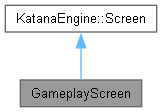
The gameplay screen for the Space Fighter Game. It is responsible for creating and loading levels. More...
#include <GameplayScreen.h>
Public Member Functions | |
| GameplayScreen (const int levelIndex=0) | |
| Instantiate a gameplay screen object. | |
| virtual | ~GameplayScreen () |
| virtual void | LoadContent (ResourceManager &resourceManager) |
| Load the content for the screen. | |
| virtual void | HandleInput (const InputState &input) |
| Handle input for the screen. | |
| virtual void | Update (const GameTime &gameTime) |
| Update the screen. | |
| virtual void | Draw (SpriteBatch &spriteBatch) |
| Render the screen. | |
| virtual void | LoadLevel (const int levelIndex) |
| Load a specific level. | |
 Public Member Functions inherited from KatanaEngine::Screen | |
| Screen () | |
| virtual | ~Screen () |
| virtual void | UnloadContent () |
| Called when resources need to be unloaded. Override this method to unload any screen-specific resources. | |
| virtual bool | IsExiting () const |
| Determines if the screen is currently exiting. | |
| float | GetAlpha () const |
| Gets the overall screen transition alpha value (or opacity). This is handy for fading screens in and out. | |
| virtual ScreenManager * | GetScreenManager () |
| Gets a pointer to the ScreenManager, for managing game screens. | |
| virtual Game * | GetGame () const |
| Gets a pointer to the Game. | |
| virtual void | SetScreenManager (ScreenManager &screenManager) |
| Gets a pointer to the ScreenManager, for managing game screens. | |
| virtual void | Show () |
| Tells the screen to transition in. | |
| virtual void | Exit () |
| Tells the screen to transition out. When the screen has completed its transition, UnloadContent() will be called, and the ScreenManager will remove it. | |
| virtual void | SetExitCallback (OnExit callback) |
| Sets the callback function for when the Exit() is called. | |
| virtual void | SetRemoveCallback (OnRemove callback) |
| Sets the callback function for when the screen is about to be removed by the screen manager. | |
| virtual double | GetTransitionOutTime () const |
| Get the time in seconds that the screen will transition out. | |
Additional Inherited Members | |
| Protected Types inherited from KatanaEngine::Screen | |
| enum class | ScreenTransition { None , In , Out } |
| Defines the state of the transition between screens. More... | |
| Protected Member Functions inherited from KatanaEngine::Screen | |
| virtual bool | ShouldHandleInputBelow () |
| Checks if the screen manager should call HandleInput on the screen below this one. | |
| virtual bool | ShouldUpdateBelow () |
| Checks if the screen manager should call Update on the screen below this one. | |
| virtual bool | ShouldDrawBelow () |
| Checks if the screen manager should call Draw on the screen below this one. | |
| virtual void | SetTransitionInTime (double seconds) |
| Set the time in seconds that the screen should transition in. | |
| virtual void | SetTransitionOutTime (double seconds) |
| Set the time in seconds that the screen should transition out. | |
| virtual double | GetTransitionInTime () const |
| Get the time in seconds that the screen will transition in. | |
| virtual ScreenTransition | GetTransition () const |
| Get the current transition state of the screen. | |
| virtual float | GetTransitionValue () const |
| Get the interpolated value (between zero and one) of the screen transition. | |
| virtual bool | NeedsToBeRemoved () const |
| Determines if the screen has completely faded out and needs to be removed by the ScreenManager. | |
| virtual void | UseRenderTarget () |
| Forces all screen rendering to a render target. | |
| virtual RenderTarget * | GetRenderTarget () const |
| Get screen's render target. | |
| virtual Color | GetRenderTargetColor () const |
| Get the color that will be used to tint the render target. | |
The gameplay screen for the Space Fighter Game. It is responsible for creating and loading levels.
Definition at line 15 of file GameplayScreen.h.
| GameplayScreen::GameplayScreen | ( | const int | levelIndex = 0 | ) |
Instantiate a gameplay screen object.
| levelIndex | The index of the level to load. |
Definition at line 17 of file GameplayScreen.cpp.
|
inlinevirtual |
Definition at line 23 of file GameplayScreen.h.
|
virtual |
Render the screen.
| spriteBatch | A reference to the game's sprite batch, used for rendering. |
Implements KatanaEngine::Screen.
Definition at line 58 of file GameplayScreen.cpp.
|
virtual |
Handle input for the screen.
| input | The current state of all player input devices. |
Reimplemented from KatanaEngine::Screen.
Definition at line 48 of file GameplayScreen.cpp.
|
virtual |
Load the content for the screen.
| resourceManager | A reference to the game's resource manager. |
Reimplemented from KatanaEngine::Screen.
Definition at line 29 of file GameplayScreen.cpp.
|
virtual |
Load a specific level.
| levelIndex | The index of the level to load. |
Definition at line 35 of file GameplayScreen.cpp.
|
virtual |
Update the screen.
| gameTime | A reference to the game time object. |
Implements KatanaEngine::Screen.
Definition at line 53 of file GameplayScreen.cpp.
 1.11.0